Prostitution Exports Expand to Include Male Variety
Aug.23,2006 20:50 KST
Digital Chosunilbo
In the midst of the already plenty disgraceful news of the pan-pacific expedition into the U.S. of Korean sex trade workers, now even Korean host bars (with male prostitutes) have been uncovered in China.
According to a statement from the Seoul Metropolitan Police on Wednesday, a 36-year-old Korean man being identified by his last name Kim is being held by Chinese authorities under suspicion of hiring male hosts to work at his sex bar. Nine men who worked at the bar have been booked here but not detained. It is alleged that Kim earned some 696,000 Yuan (W83.5 million; US$1=W956) in illegal profits through his business venture that catered to Chinese women and Korean female tourists between December of last year and February of this year. Police say that Kim employed his own style of "Korean Wave marketing": proudly noting on the handbills and Internet ads that the men were Korean.
A police insider says, "The male workers would either perform a nude show, or perform various other kinds of lewd acts using their naked bodies." The establishment was uncovered by Chinese public security officials in February, and the owner is currently being tried, while the employees were deported after serving 15-30 days in prison. Police say that they have received a statement from Kim that he even had a recruiter to bring Korean men and Korean Chinese to work at his bar. Police are currently trying to locate the man.
(englishnews@chosun.com )
Thursday, August 31, 2006


Wednesday, August 30, 2006
From Christianity Today
Christianity Today, September 2006
Q&A
Nicholas Kristof
Interview by Collin Hansen | posted 08/30/2006 09:30 a.m.
What has your reporting taught you about Christianity in China?
Christianity has certainly been growing since the early 1980s. But in the past there's been a certain stigma attached to it among some intellectual quarters, because often the Christians have been peasants. It struck me that in the last few years there have been more intellectuals in the cities converting to Christianity.
To some degree Christianity has also become linked to democratic protest in a way that reminds me a lot of South Korea in the 1980s. I think the government is really nervous about how to deal with this. Christianity creates networks of people around the country, which is something that traditionally the Communist Party has not faced. It creates a source of moral authority and legitimacy that is outside the government. In Poland the Communist Party had this terrible problem with the Catholic Church. The Chinese never had anything remotely like that. The Christian church may be the beginnings of such a framework. And the fact that President Bush is a Christian, is concerned about Christians in China, that gives Christians in China a measure of protection that Falun Gong, for example, does not. China would not get away with beating to death lots and lots of underground Christian church leaders.
In this country we somewhat exaggerate the degree of repression against Christianity. It's very real, but it tends to be somewhat localized. Your average Christian in China hasn't been threatened, doesn't know anybody who's been beaten up. Christianity to some degree has become cool. It's become kind of a famous brand in the same way people want to have brand name clothes or carry a brand name purse. There is an element in China of Christianity being a brand name religion.
What are some ways that Christians in America can encourage the growth of Christianity in China?
I don't think we should exaggerate our ability to shape what goes on in Chinese society. All those vast efforts to send missionaries to China early in the 20th century really didn't get very far. The future of faith in China is going to be determined by the Chinese themselves. Where you get Christians who are arrested, beaten up, I think Americans can and should play a role in denouncing those kinds of abuses and speaking out against those kinds of injustices.
But if Christians are perceived as a fifth column or as pawns of Americans, that will discredit it. China is a deeply nationalist country. Americans should also be a little bit leery because Christianity in China covers a huge range. There are also a number of cults that call themselves Christians. When they get in trouble, they try to get help from the West.
Christians shouldn't only speak up on behalf of Christians who are tortured. Falun Gong is bearing the biggest brunt of religious repression in China. It behooves the American evangelical community to speak up when Falun Gong believers are tortured or their children taken away.
Wednesday, August 23, 2006
BBC report on China and Human Trafficking
I am sorry about such a long delay. I have been working on finishing my final paper for school which I did last week. Anyway, I am planning on getting updated on blogger now.
Below is a copy of a recent BBC article on the sex trade in China
BBC News in video and audio
News services
Your news when you want it
News Front Page
World
Africa
Americas
Asia-Pacific
Europe
Middle East
South Asia
UK
England
Northern Ireland
Scotland
Wales
Business
Politics
Health
Education
Science/Nature
Technology
Entertainment
-----------------
Have Your Say
Magazine
In Pictures
Country Profiles
In Depth
Programmes RELATED BBC SITES
SPORT
WEATHER
CBBC NEWSROUND
ON THIS DAY
EDITORS' BLOG
LANGUAGES
Chinese
Vietnamese
Indonesian
More
Last Updated: Wednesday, 9 August 2006, 21:50 GMT 22:50 UK
E-mail this to a friend Printable version
China slow to wake up to human trade
By Jill McGivering
BBC News, Yunnan
Young girls in Yunnan want to go to cities or abroad to find jobs
As China opens up, people trafficking is emerging as a growing threat, but officials are reluctant to admit the scale of the problem.
In Yunnan province, young women are being sold as wives or to brothels and sweat shops in Thailand.
Life in the small Yunnan villages, close to the border with Burma, is very different from other parts of China where the economy is booming. This is a sleepy world of lush rice paddies, hillsides bursting with rubber trees and dotted with Buddhist temples.
Many villages here contain ethnic minorities whose language and culture has more in common with northern Thailand than with the Han Chinese.
Local people say trade across the border with Burma has fallen. So too has tourism. So for young people growing up in these small hillside villages, there is little opportunity.
Every year, thousands of them pack up and leave, heading for China's cities or crossing through Burma to Thailand in the hope of well-paid jobs.
Some do make money and come back to the villages to show off their success. That only encourages more young people to follow suit. But for an unknown but perhaps growing number, it all goes horribly wrong.
'Tricked'
Trafficking is a hugely sensitive subject here. Officials do not really want to talk about it. And neither do victims. It took a lot of negotiating to find a young woman who was prepared to speak out for the first time and tell her story publicly.
Qing-qing says human trafficking has become a cycle
Qing-qing is 19 now but when she was just seven years old, she and her mother were sold.
"A woman my mother knows came to our house with some men we hadn't seen before," she told me. "My mother was tricked. They sold her as a bride to a man in eastern China."
The man beat her and her mother, she said, close to tears. At the age of 12, Qing-qing was forced to leave school and go to work. Their ordeal continued for eight years before they managed to escape and come home to their Yunnan village.
I asked her if this trafficking of vulnerable women still went on. "Yes," she said. "It's still going on in nearby villages."
"I know people who went through the same experience as my mother. Later some of them came back to the village to trick other people in the same way. It's become a cycle."
Teenagers
It was very difficult to find officials who could give a clear picture of the scale of trafficking.
One local Communist Party secretary told us it was certainly a potential threat, as more people migrated, but insisted it did not happen in his small community. But anecdotal evidence is widespread.
Long Hai-yu has been studying trafficking in Yunnan's villages for the last two years. She took me to one small village which she asked me not to name.
She talked to me about a case there involving two teenage girls who were recruited by strangers at the end of last year.
They were promised jobs in a shoe factory in Thailand, she said. But once the men took them across the border, they were blindfolded. The men started to threaten them and demand money from their families.
In fact, the two girls managed to raise the alarm and were rescued before they were taken any further, but Long Hai-yu said she thought they would have been sold into the Thai sex industry.
Not very much is known about who exactly the traffickers are. Long Hai-yu says they are Chinese people from another province, perhaps Sichuan province. They are not Thai, she explained, because it is too hard for Thai people to come to the villages to recruit girls.
Thousands cross from China into Burma every year
As for numbers, it is impossible to know. Once young girls leave for another country like Thailand, it is hard for their families to find out what has happened to them.
Long Hai-yu said that at just one nearby border point about 2,000 people cross into Burma every year.
"Many go to work in nightclubs and bars," she said, shrugging her shoulders. "Who knows how many are trafficked?"
'Can't happen here'
The Chinese authorities are just starting to take action. Here in Yunnan they have set up the country's first anti-trafficking programme.
I watched two young women act out a play, one playing a cruel trafficker and the other a desperate trafficking victim who despairs and finally kills herself. But everyone in the audience got the message.
"Trafficking is when your boss doesn't give you all the money he owes you when you leave," said one girl.
A man sounded a reassuring note. "There's no need to worry," he said. "The government policy is good. Trafficking can't happen here."
But despite the reluctance to talk about it, all the evidence on the ground suggests trafficking is happening.
Researcher Long Hai-yu said she was extremely worried.
"The pattern is already changing," she told me. "Traffickers are targeting younger and younger girls, as young as 16."
As China opens up, its new freedoms are bringing new dangers. But they will be hard for the country's Communist system to address until it changes its culture of embarrassment and secrecy.
Tuesday, May 30, 2006
This little piggy went to the mountain
As our time ended with the villagers, we were led further up the mountain. It was there that we saw the fate of the squealing pig we had heard earlier in the day. We were led into a house that had been built on stilts. The sides were planks of wood about 12 inches wide. There were small cracks between where the planks fit together. I imagined the temperature inside when it was winter time. The floor was made of a strip of weaved Bamboo that flexed and bounced like a trampoline as you walked on it. The roof looked like the roof of a hut from Gilligan's island. In the middle of the floor was a fire pit which was used for cooking and warming the hut. What a vulnerable place for fire. I wonder how many times the houses burn down?
As I went inside I found Duncan, Mr. Go, Puisi and Major Yoo all sitting around a pot of food. There was a stool at their table for me to sit at. We started out with some very cooked meat. It was cooked to a charcoal. The first thing I picked up was a rubbery, curly thing. Mr. Go and the rest of the table began laughing. In their minds this piece of meat might have been that "worst possible" part of a male pig to eat. One bite was enough for me. I slowly eased the rest of my piece back into the bowl. I suddenly or maybe not so suddenly sensed the urge to use the restroom. I asked the table where I should go? Duncan said to just go outside and go wherever I wanted.
I walked outside. There wasn't a grove of trees in sight. The area was wide open. Two guys came out of the back of the house. They were trying to figure out what I was doing. Not able to speak their language I was embarrassed to make hand motions. Dr. Smith came out and needed to go to the restroom as well. he motioned the guys that we needed to go. They took us to a little grove of trees where we were able to use the restroom in partial privacy.
Upon returning to the house I found that my bowl had a chicken foot in it. They had placed the foot so that it would grab the bowl from which it had come. Mr. Go was laughing hysterically. As I had already eaten chicken foot on this trip, I passed the foot over to Duncan.
Soon it was time to head back down the mountain. The villagers accompanied us down to the place where the four costumed girls had met us earlier in the day. From their we went on with just our group.
the rain picked up at this point. The hill became very muddy and we were sliding as we made our way down the hill. As the cows were living all over the hill there was cow dung in the middle of the path in many places. On the way up the path had been much drier allowing for more control. Plus, comind down a mountain is a bit like controlled falling. Therefore, my foot found the middle of the pile of manure. Major Yoo who was walking directly behing me thought this was hilarious. she said that I had to journal it. Thus, that's why your reading this.
I made it down the mountain about 100 yards ahead of the other guys on our team. I was traveling with a group of the locals. Getting down was quite an achievement. I immediately went to a fountain and washed my shoes. The altitudes and the climb had worn me out.
Wednesday, May 10, 2006
Eat honey, My son, for it is sweet
The trip became very slippery as the rain continued. At one point as we were climbing there was a cow standing on the side of the path. The cow slipped and began falling toward me. I backed up to keep from getting run over by the beast. AS we neared the village there was a spot where you could hear your voice echo for miles. Duncan was yelling hello to himself. So I yelled, "J-Roc." It bounced back and forth off the mountain walls.
The high altitudes were another great obstacle for us. Just a few feet 20 or 25 and I was highly out of breath. Well, as we were climbing the mountain the president of the women's federation offered to take my backpack. I refused. I didn't think it would show my southern gentleman traits which I had been brought up with. Half way up the mountain however I was drenched with sweat. She didn't have a drop of sweat on her. She offered again. So, I am not sure what happened next but somehow she had the backpack and we were off and up the mountain again.

When we arrived at the village we were greeted on a basketball court by a group of villagers. They served us some honey straight from the comb. It was some of the sweetest honey and a great way to rest from the long journey we had just been on.


Later, I found that Proverbs 24:13,14 says:
Eat honey, my son, for it is good; honey from the comb is sweet to your taste. Know also that wisdom is sweet to your soul; if you find it, there is a future hope for you, and your hope will not be cut off.
I was struck by the irony of a village whose lifeline and hope was being cut off through the pillaging of its women, serving as its welcoming dish, a bowl of honey. It reminded me that there is hope for this village.
As we were sitting there eating honey we heard a pig squealing in the distance. Dr. Mike asked someone why the pig was squealing and he was told they were preparing supper.
We met with the leader of the village and he answered a few questions for us. There were four girls who were dressed in traditional dress representing there village. Each dress cost 100 rmb to make or $12 US Dollars. In the village each person makes about 10 cents a day. So a $12 dollar dress would be worth about 4 months salary. I reflected that with 1.3 billion people in China, if you equally divided the Kroc donation you could give each person around $2. In this village that $2 would be equal to almost a month's salary.
Once we got passed the intial meeting Dr. Smith and I moved to a house with a son whose mom had been trafficked. The mom left for the market one day and never returned. Some other women saw her in a different region.
It was a very difficult interview. There we were, outsiders, who had never been to this village ot met these people and we were asking them questions about a time in their life when they had been completely abandoned by the one's they loved the most. The pain was obvious in his eyes.

As we talked with this family another lady was there who began to tell us about her situation. She had been married to a wonderful man. He passed away. She then remarried. This man treated her very badly. She explained that he dinks all the time. He is not a Christian. She explained that many of the men in the village had become Christians. The Christians were kind to their wives and had put alchohol aside. She was moved to tears and it was obvious that her pain was deep. As the tears streamed down her cheeks Peggy began to get out a tissue. Dr. Smith stopped her. He told Peggy that giving her a tissue would keep the lady from crying. He said that the lady needed to cry. He was probably right, being a PhD and all. But I couldn't help asking myself what was behind the tears? Perhaps the discussion about trafficking and leaving had brought to her mind the thoughts SHE had been having about leaving. I don't know this to be the case but it was certainly the sense I got. Perhaps her tears were not just about the sadness about the situation she was in but also tears of remorse about the decision she was contemplating. It must have been difficult for her to sit there and see the pain of the thirteen year old boy left without a mother and consider the way her actions could hurt her children and the rest of the village.
The high altitudes were another great obstacle for us. Just a few feet 20 or 25 and I was highly out of breath. Well, as we were climbing the mountain the president of the women's federation offered to take my backpack. I refused. I didn't think it would show my southern gentleman traits which I had been brought up with. Half way up the mountain however I was drenched with sweat. She didn't have a drop of sweat on her. She offered again. So, I am not sure what happened next but somehow she had the backpack and we were off and up the mountain again.

When we arrived at the village we were greeted on a basketball court by a group of villagers. They served us some honey straight from the comb. It was some of the sweetest honey and a great way to rest from the long journey we had just been on.
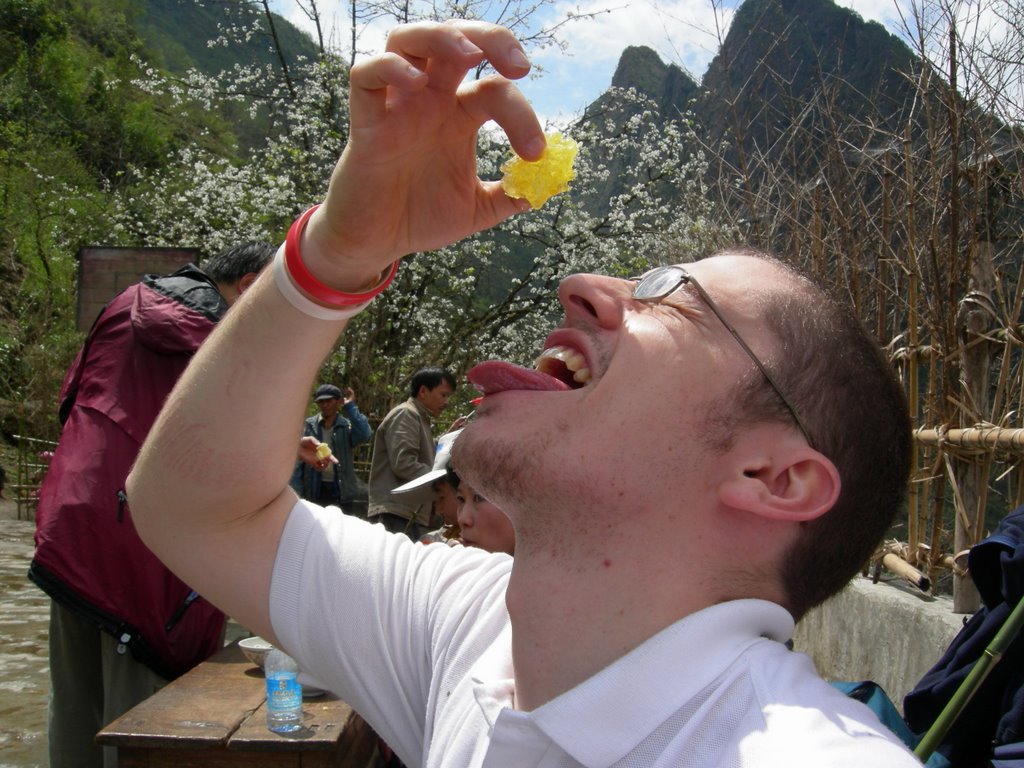

Later, I found that Proverbs 24:13,14 says:
Eat honey, my son, for it is good; honey from the comb is sweet to your taste. Know also that wisdom is sweet to your soul; if you find it, there is a future hope for you, and your hope will not be cut off.
I was struck by the irony of a village whose lifeline and hope was being cut off through the pillaging of its women, serving as its welcoming dish, a bowl of honey. It reminded me that there is hope for this village.
As we were sitting there eating honey we heard a pig squealing in the distance. Dr. Mike asked someone why the pig was squealing and he was told they were preparing supper.
We met with the leader of the village and he answered a few questions for us. There were four girls who were dressed in traditional dress representing there village. Each dress cost 100 rmb to make or $12 US Dollars. In the village each person makes about 10 cents a day. So a $12 dollar dress would be worth about 4 months salary. I reflected that with 1.3 billion people in China, if you equally divided the Kroc donation you could give each person around $2. In this village that $2 would be equal to almost a month's salary.
Once we got passed the intial meeting Dr. Smith and I moved to a house with a son whose mom had been trafficked. The mom left for the market one day and never returned. Some other women saw her in a different region.
It was a very difficult interview. There we were, outsiders, who had never been to this village ot met these people and we were asking them questions about a time in their life when they had been completely abandoned by the one's they loved the most. The pain was obvious in his eyes.
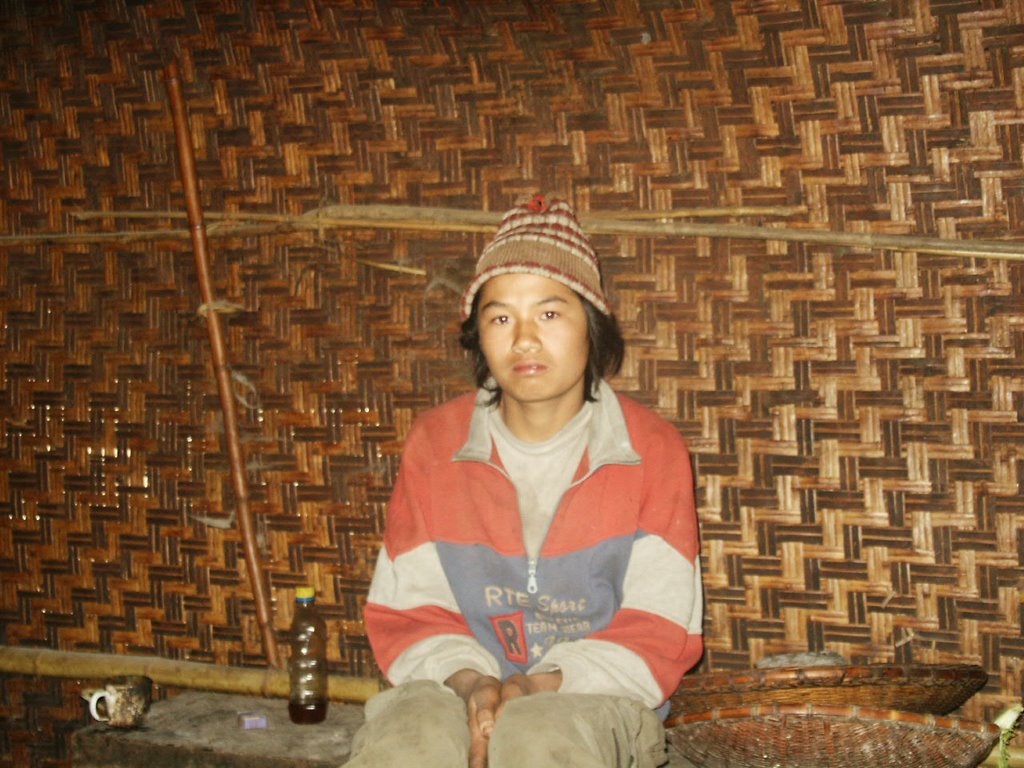
As we talked with this family another lady was there who began to tell us about her situation. She had been married to a wonderful man. He passed away. She then remarried. This man treated her very badly. She explained that he dinks all the time. He is not a Christian. She explained that many of the men in the village had become Christians. The Christians were kind to their wives and had put alchohol aside. She was moved to tears and it was obvious that her pain was deep. As the tears streamed down her cheeks Peggy began to get out a tissue. Dr. Smith stopped her. He told Peggy that giving her a tissue would keep the lady from crying. He said that the lady needed to cry. He was probably right, being a PhD and all. But I couldn't help asking myself what was behind the tears? Perhaps the discussion about trafficking and leaving had brought to her mind the thoughts SHE had been having about leaving. I don't know this to be the case but it was certainly the sense I got. Perhaps her tears were not just about the sadness about the situation she was in but also tears of remorse about the decision she was contemplating. It must have been difficult for her to sit there and see the pain of the thirteen year old boy left without a mother and consider the way her actions could hurt her children and the rest of the village.
Thursday, April 27, 2006
Eye has not seen...Day whatever it is now...in China...
[I apologize some of the photos wouldn't download for me. So I will try to get them in tommorrow.]
From my journal:
4/03
6:45 AM
Hotel
"Eye has not seen nor has ear heard nor has mind conceived the things God has planned for his people" 1 Corinthians 2
Yesterday we spent around eight hours driving on the minibus through the mountains. The roads swerrved at every turn. They were filled with foot pedestrians. As the bus made its way, the driver would honk the horn every time we neared anyone, which was all the time. This was to give them fair warning no to enter the road. Our road followed the river which cut its way into the mountains. Every mile that we drove took us deeper and deeper into the mountains. The faces on either cliff stretched high into the sky. The sun shone just on the top half of one side as it slipped slowly below the mountain range.
All along the way we saw people hard at work. They were busy doing manual labor. There were large boulders being broken by hand with sledge hammers. There were ten foot deep holes, ten foot in diameter being dug in the sand by shovels Erosion and landslides left huge piles at the bottoms of the mountains to be cleaned up. Platforms had been built into the sides of the mountains to try to stop some of the erosion and to provide some areas for farming. These unfortunately only worked some of the time before giving way to erosion and leaving that portion of the land useless.

I couldn't help reflecting on how people's lives were shaped as well. There some houses built into the sides of the mountain. I can only imagine walking out of my house on a brisk April morning, smelling the freshness of the air, seeing the river below and the mountain ranges that surrounded me, and feeling overwhelmed and inadequate to be in such a beautiful place. I can only imagine the joy that would inspire within me. And yet there are other forces shaping people as well. The hardship of the work it takes to survive. The constant day in and day out physical exertion. And I thought that this was something the whole of the human race faces. In the same way the river and the rains had shaped the sides of the mountain, people's lives are shaped by their circumstances. It is a mixture of joy and hardship that over time carves out who we are. I guess the question is if we have enough joy in our lives to make the carved out mountains look grandeur?
We arrived after 8:00 pm last night. The first thing we did was to put our bags in the room and then head immediately to dinner. At dinner we met the county leaders. They served us a wonderful meal. I was encouraged to eat pig fat. It is just a sqare piece of pig fat. The government projects officer for the region was rooting me on. I put the whole thing in my mouth and continued to add rice and it started to go down. This seemed to find favor with everyone that was serving us.
From there we moved to the police headquarters for a beuracratic type meeting. Everyone was introduced and tok turns sharing pleasantries and hopes for the partnership. The county leaders shared with us the problem in their eyes. This included trafficking as well as urban migration. They seemed to point to the greatest need as being poverty alleviation.
The next day we headed towards the village. We drove about an hour before we arrived at the trail to the village. We had come a long ways to get to this village. What would we find there? About forty five minutes into the climb up the mountain we began to realize the altitude was going to make this climb much tougher The weather was cool and yet I was POURING sweat. For some time we ascended a rocky trail but then came to flat concrete walking wall. This was a good reprieve only about a third of the way up the mountain. Once passed this we were back on the rocky trainl and it began to rain. The rain made the trip more difficult as it became muddy and slippery.

We continued upward around another hour and fifteen minutes. We passed some workers farming the mountainside. We passeed a temporary camping site for men building a power station.
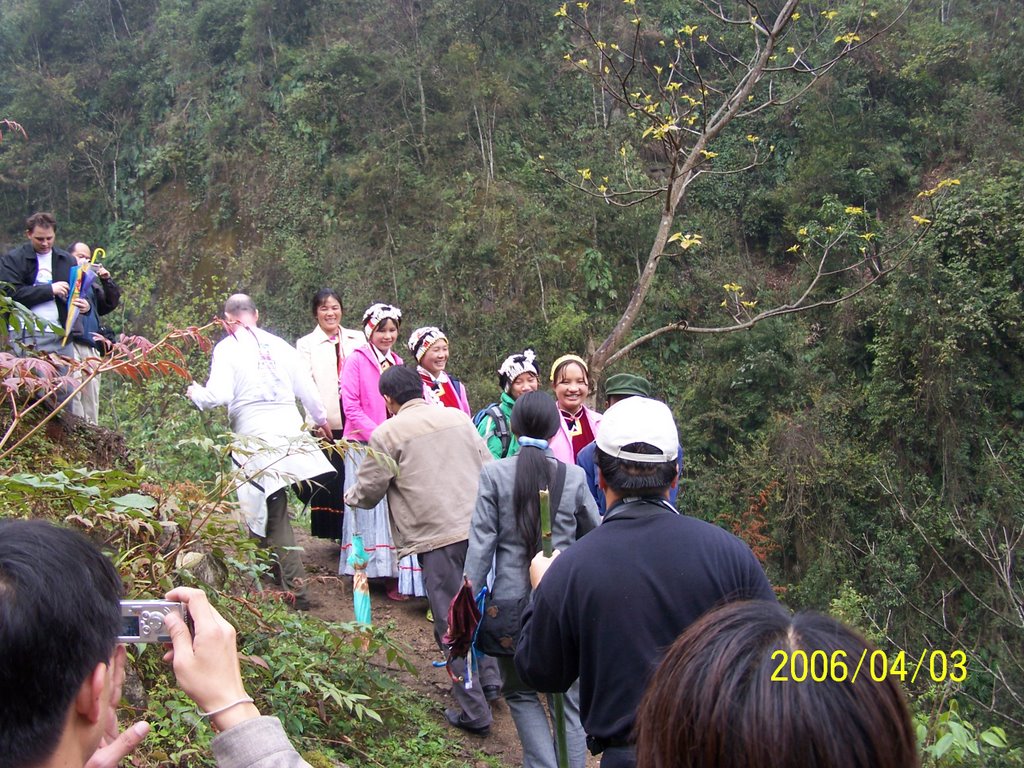
We came to a place where there were four costume dressed girls and an older man. They were waiting on us to carry our bags to the village. They greeted us by singing, "To God Be The Glory" in their language. This was the biggest shock of our trip yet. What a blessing to be standing so far up on this mountain in the middle of China and be greeted by such a familiar and fitting song. We had learned that the villagers were Christians from an earlier debriefing. Some English missionaries had come and given them a written alphabet. Until then their language had not been written down. I was anxious to see what role Christianity was playing in helping to sustain their village.
Thursday, April 20, 2006
China - Day Five
Journal:
"Ahhh. aisle seat. We are on ANOTHER airplane. [this is my fourth airplane]. I am struck finally by how far it is to the villages we are headed to. 14 hour flight ATL to Tokyo--4 hour flight Tokyo -- Hong Kong -- 3 hour flight Hong Kong Kunming -- one hour flight kunming--to the next city [as mentioned last blog from here on out I will leave out the names]--6 hour bus ride to another city --2 hour hike."
Blog:
As at this point I have written three blogs and am yet to reach the villages I think you could sense the frustration that I began to feel. But I also began to feel like perhaps God had a big plan. If he had to take me so far to reach this point of need then there must be something big for me to see. As we left the airport the terrain began to change. There was the river along the side of the road that we seemed to follow. Hills lined both sides of the road and the river.

As we went further the hills became mountainside and the terrain began to rival that of Colorado.


The road was very rocky and the bus ride that was supposed to take 6 hours seemed to drag on. At one point we came to a place where all traffick was stopped because they were working on the road. So what did we do? What else do westerners do when they are bored? We made a game out of it.
Seeing the river was a good distance a way we decided to challenge each other's throwing arms.

Finally we were back on the road and by about 8 pm we arrived in the city we were staying in. And if you have been reading this blog then you might be feeling a bit like I was up until this point. When will the action start? Well...this is where our assessment began.
Monday, April 17, 2006
China - Day Four
Some of the city names I have been told to omit by The Salvation Army. This is to keep the precise region we were were working in confidential.
Day Four
We began the day off in Hong Kong. So before we went to the airport I made my way down to what has become known to me as the universal language--basketball.

I found out that ten feet in the US is ten feet in China.
Later that day we boarded the plane for kunming. After about a three hour flight I was on the ground in mainland China. We flew into Kunming. There we were met at the airport by Jerry the projects officer. The rest of the development staff met us at dinner that night.
From my journal:
"After dinner I was ablet to lean back in my chair and have some personal conversation with Puisi. She is the director of development for The Salvation Army in China. She is an incredible woman. Until the age of 29 she had not received a degree. She went from Hong Kong to Australia to study. While there she attended an anglican church. She was not impressed because the status of church members and what they did for a living was a very big deal. She wanted religion that was practical to her. She gained a degree in nursing and later a Masters in public health. She began attending The Salvation Army corps and became a soldier. She went to work for world vision. She worked for them for several years but The Salvation Army came looking for her. Since she was a soldier she agreed strongly with the mission of the army. in 1997 she started work in Kunming China. She was the army in all of China. One person among a billion. That is the spirit of this woman. She knows she can make a difference. It is to her credit that today there is a staff of 10 in Kunming and 8 in Bejing."

Day Four
We began the day off in Hong Kong. So before we went to the airport I made my way down to what has become known to me as the universal language--basketball.
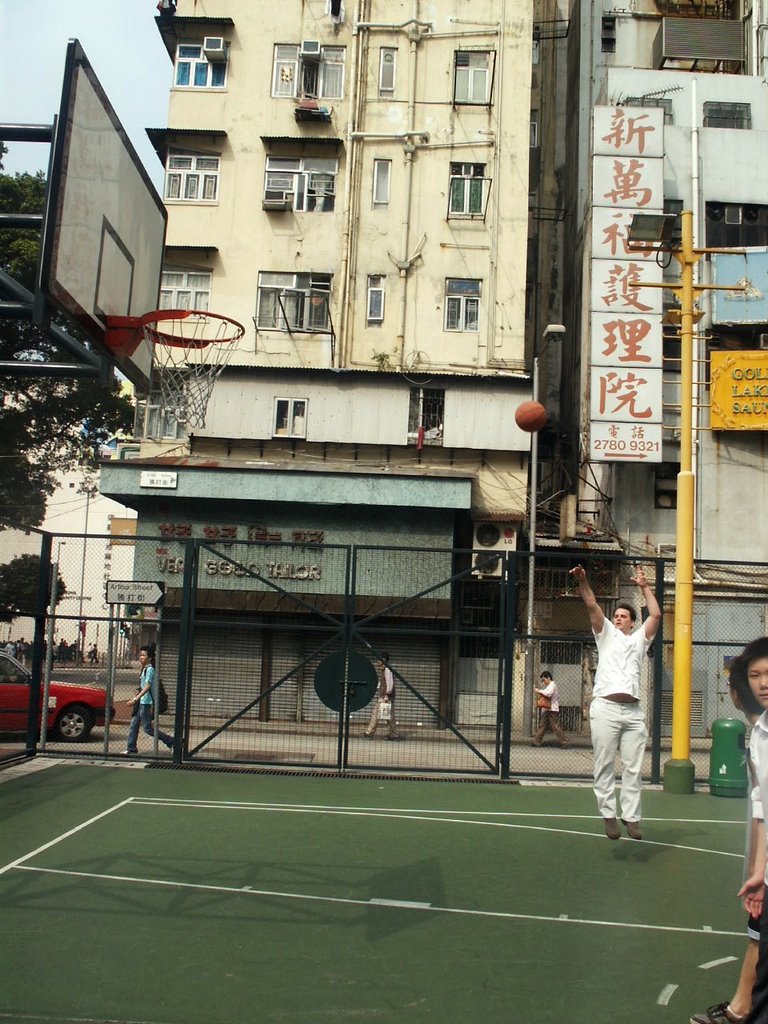
I found out that ten feet in the US is ten feet in China.
Later that day we boarded the plane for kunming. After about a three hour flight I was on the ground in mainland China. We flew into Kunming. There we were met at the airport by Jerry the projects officer. The rest of the development staff met us at dinner that night.
From my journal:
"After dinner I was ablet to lean back in my chair and have some personal conversation with Puisi. She is the director of development for The Salvation Army in China. She is an incredible woman. Until the age of 29 she had not received a degree. She went from Hong Kong to Australia to study. While there she attended an anglican church. She was not impressed because the status of church members and what they did for a living was a very big deal. She wanted religion that was practical to her. She gained a degree in nursing and later a Masters in public health. She began attending The Salvation Army corps and became a soldier. She went to work for world vision. She worked for them for several years but The Salvation Army came looking for her. Since she was a soldier she agreed strongly with the mission of the army. in 1997 she started work in Kunming China. She was the army in all of China. One person among a billion. That is the spirit of this woman. She knows she can make a difference. It is to her credit that today there is a staff of 10 in Kunming and 8 in Bejing."

Friday, April 14, 2006
China - Day Two Continued and Three
Tokyo - Meeting Interesting People
It always seems that I meet the most interesting people when I am on mission trips. On my flight from Atlanta to Tokyo I sat next to an individual who was currently living in Brazil but had lived in Tokyo and in China. He had worked on exporting oil paintings out of China. He talked about how he had always wanted to get involved with philanthropic work but that he had only so far worked in business.
Later, I met some Americans at the terminal in Tokyo who were also heading to China. It was a bit surreal, partly because jet lag was settling in, but we all sat and talked for a couple of hours in Tokyo and it was almost like we had known each other for a while.
Hong Kong
When I finally made it to the airport in Hong Kong I had been traveling close to twenty four hours. I was tired. I just wanted to get my bags and drop into bed. But first I had to go through customs. I think customs is a metaphor for life. Perhaps some of the worrying that I had been doing related to this metaphor. When you get to a new stage in life at times there is a waiting period. Anxiety builds as you await entrance into that new land of what God has for you. Will I be accepted? What's on the other side?
Well literally after a wait in line I was accepted into Hong Kong and strolled to where I met the taxi. You can go back to my last blog to catch that the taxi went fine and I got in my room, met my roomate and went to sleep.
Day Three - Hong Kong Cont.
This is straight from my journal:
"I had some great conversations with Duncan, who informed Dr. Michael Smith

and I about what to expect in mainland China. It was exciting because he said that some of these villages are like "viking villages." they are very primitive with little touched by technology. He also said that Colonel Tsang [officer commanding in Hong Kong] expected to have corps operating in mainland China within 10 years."
I didn't have time to journal the rest of the day so the next day I penned this about this day:
"Yestaerday was great. We spent the day in the board room discussing human trafficking.

I was jetlagging pretty hard but I sensed that India has had the most success in this work.

The thing that I got the most from this meeting was that the army has barely scratched the suface when it comes to getting involved with this type of ministry."
The session actually seemed to be much more a brainstorming session about how we can work together internationally to combat this problem. I was left convicted that I needed to do something about it back home.
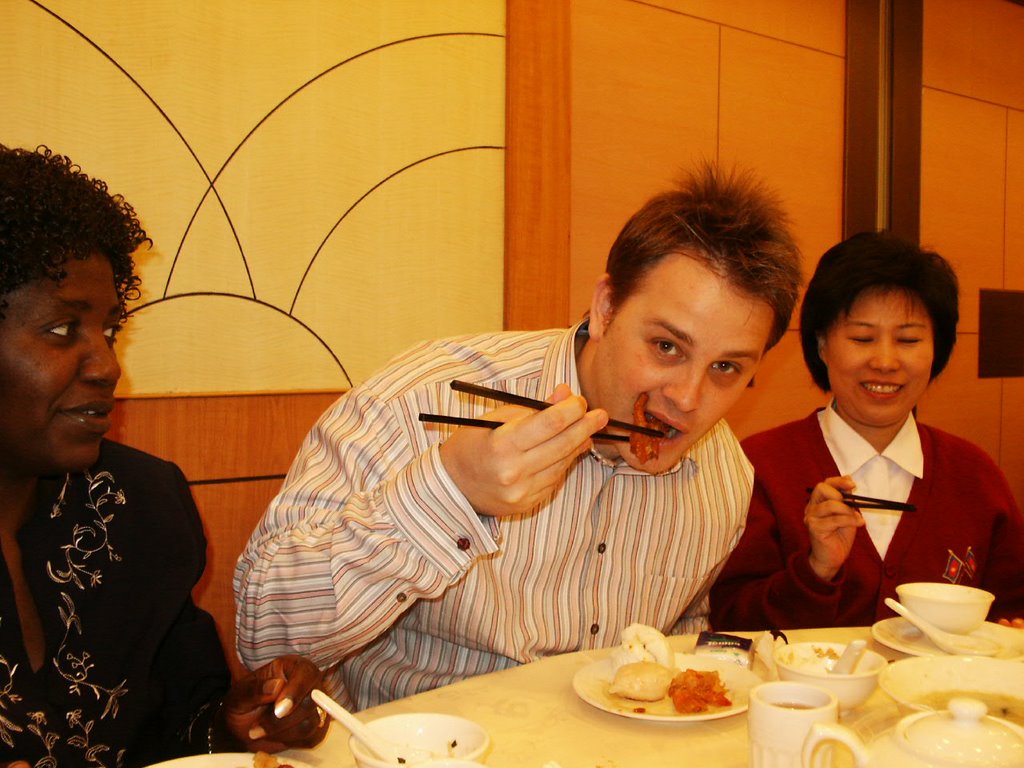
For Lunch we were hosted by Colonel Alfred Tsang who is the officer commanding for the Hong Kong and Macau command. He seemed to be a very energetic man and supportive of thejourney that we were about to take. I had never eaten chicken feet before but this was thrust on my plate and I found that it "taste like chicken."

With the preliminary meetings over my gaze began to turn to mainland China. The next day we would depart to begin our assessment of what we can do there.
It always seems that I meet the most interesting people when I am on mission trips. On my flight from Atlanta to Tokyo I sat next to an individual who was currently living in Brazil but had lived in Tokyo and in China. He had worked on exporting oil paintings out of China. He talked about how he had always wanted to get involved with philanthropic work but that he had only so far worked in business.
Later, I met some Americans at the terminal in Tokyo who were also heading to China. It was a bit surreal, partly because jet lag was settling in, but we all sat and talked for a couple of hours in Tokyo and it was almost like we had known each other for a while.
Hong Kong
When I finally made it to the airport in Hong Kong I had been traveling close to twenty four hours. I was tired. I just wanted to get my bags and drop into bed. But first I had to go through customs. I think customs is a metaphor for life. Perhaps some of the worrying that I had been doing related to this metaphor. When you get to a new stage in life at times there is a waiting period. Anxiety builds as you await entrance into that new land of what God has for you. Will I be accepted? What's on the other side?
Well literally after a wait in line I was accepted into Hong Kong and strolled to where I met the taxi. You can go back to my last blog to catch that the taxi went fine and I got in my room, met my roomate and went to sleep.
Day Three - Hong Kong Cont.
This is straight from my journal:
"I had some great conversations with Duncan, who informed Dr. Michael Smith
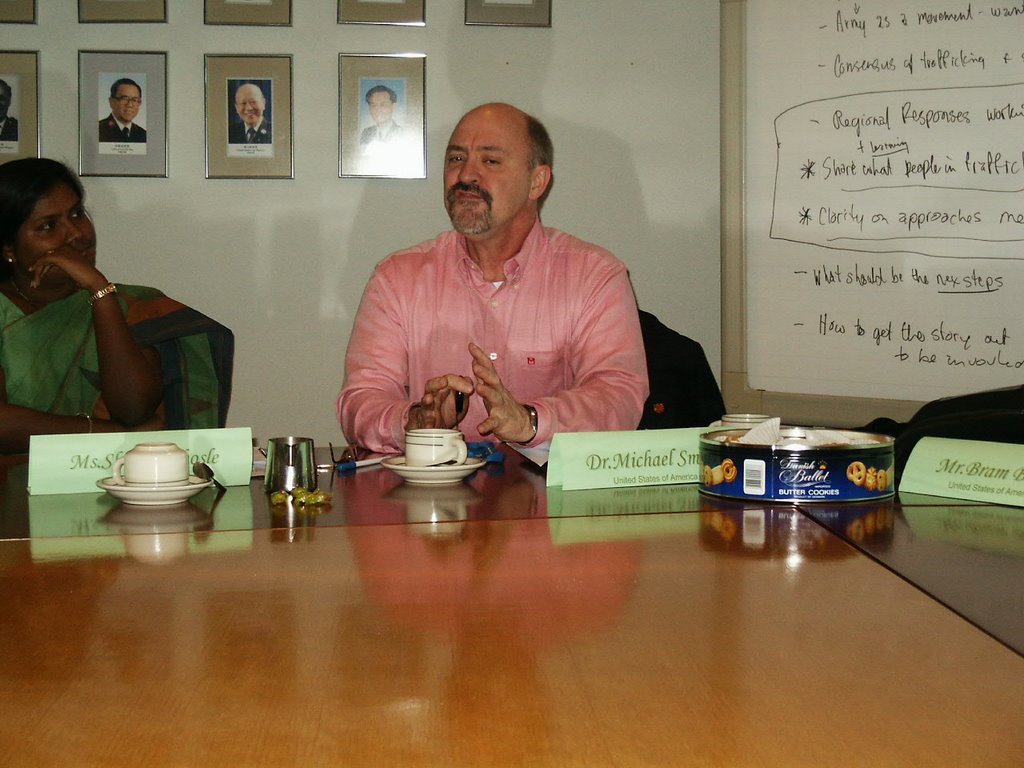
and I about what to expect in mainland China. It was exciting because he said that some of these villages are like "viking villages." they are very primitive with little touched by technology. He also said that Colonel Tsang [officer commanding in Hong Kong] expected to have corps operating in mainland China within 10 years."
I didn't have time to journal the rest of the day so the next day I penned this about this day:
"Yestaerday was great. We spent the day in the board room discussing human trafficking.
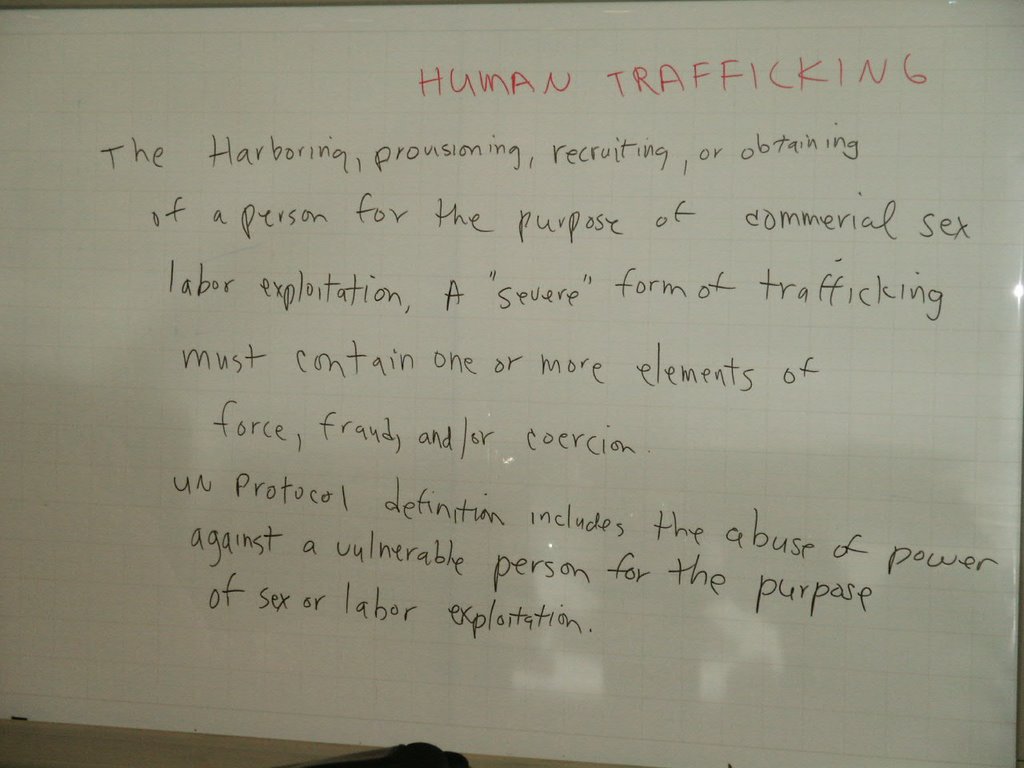
I was jetlagging pretty hard but I sensed that India has had the most success in this work.
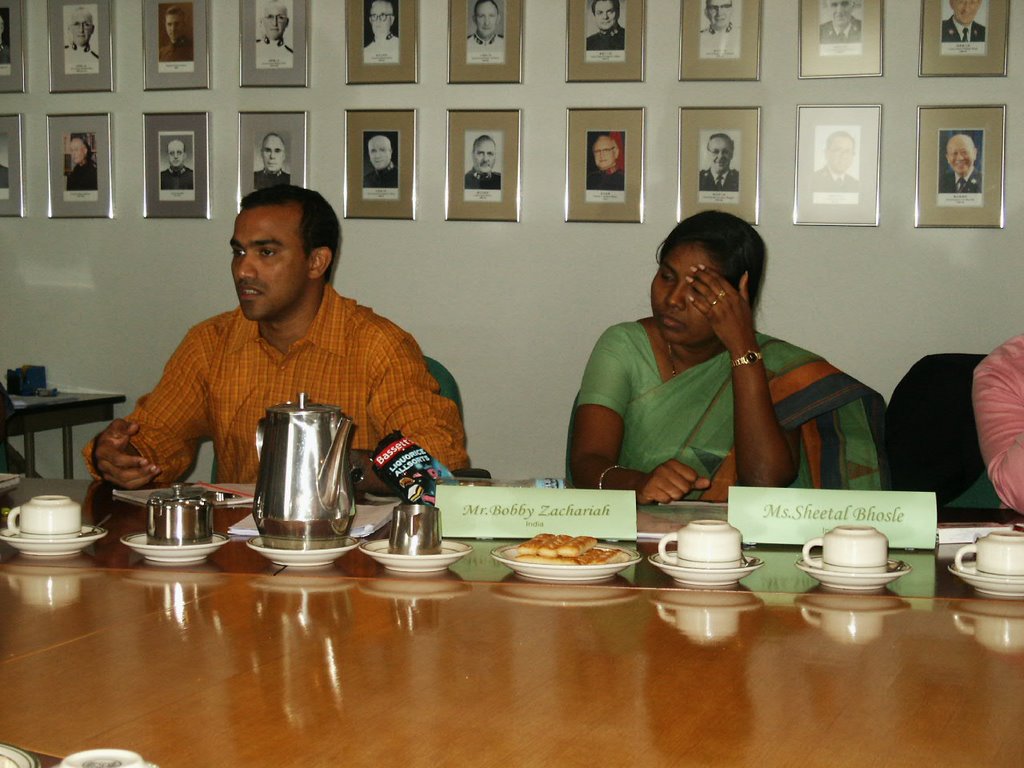
The thing that I got the most from this meeting was that the army has barely scratched the suface when it comes to getting involved with this type of ministry."
The session actually seemed to be much more a brainstorming session about how we can work together internationally to combat this problem. I was left convicted that I needed to do something about it back home.
For Lunch we were hosted by Colonel Alfred Tsang who is the officer commanding for the Hong Kong and Macau command. He seemed to be a very energetic man and supportive of thejourney that we were about to take. I had never eaten chicken feet before but this was thrust on my plate and I found that it "taste like chicken."
With the preliminary meetings over my gaze began to turn to mainland China. The next day we would depart to begin our assessment of what we can do there.
Thursday, April 13, 2006
My Trip to China Day One and Two
Well, I am back. I want to thank everyone who supported me through prayer or finances. So I am going to go back to the first day and try to chronicle my trip.
Wed. March 28th
Got all packed up...its funny how dog's can sense when I am getting ready to go on a long trip...

The whole night before I left to go on the trip I couldn't sleep. Here are some of the thoughts from my journal:
"I'm distracted. It has not been the best day. Big thoughts, Big worries about things here in the states have consumed most of my day. Here I am just a few hours before take off and I am focused on things weeks ahead. I am reminded of a previous mission trip I took where the Lord taught me to live in the moment I am in.
Sometimes it seems the enemy's plan is to get us thinking about the next important thing so much that we miss the ministry and magic of the moment. What might lie ahead for me? May I struggle to find my way from the Hong Kong airport to the place where I am staying at close to midnight by myself? Sounds like a bad episode of the amazing race. Will I be on the same page with the rest of the team? Will there be a spiritual application to the trip or just a physical one? Will I look into the eyes of a hurting kid in China and know that I have to do something? Will I be in touch closely enough with the heart of God to cry with Him?"
March 29th - 30th
The next day I got a plane for a long flight to Tokyo and then on to Hong Kong.

It was thirteen hours ahead in Hong Kong so I left Wednesday morning at 10:30 am and arrived Thursday night at 10:30 pm. But I actually spent around 24 hours of actual travel time including a four hour lay over in Tokyo.
The Salvation Army in Hong Kong has a beautiful hotel and command headquarters. I checked into the room and met my roomate Duncan Parker. Duncan is the Director for International Development for the United Kingdom. He greeted me by saying, "I hear I should call you J-Rock." I couldn't believe that my nickname had made it around the world:)

So as I lay in bed that night around midnight over there, 11 am back here in the states I felt excited about the days ahead and the place where the Lord had brought me.

Wed. March 28th
Got all packed up...its funny how dog's can sense when I am getting ready to go on a long trip...

The whole night before I left to go on the trip I couldn't sleep. Here are some of the thoughts from my journal:
"I'm distracted. It has not been the best day. Big thoughts, Big worries about things here in the states have consumed most of my day. Here I am just a few hours before take off and I am focused on things weeks ahead. I am reminded of a previous mission trip I took where the Lord taught me to live in the moment I am in.
Sometimes it seems the enemy's plan is to get us thinking about the next important thing so much that we miss the ministry and magic of the moment. What might lie ahead for me? May I struggle to find my way from the Hong Kong airport to the place where I am staying at close to midnight by myself? Sounds like a bad episode of the amazing race. Will I be on the same page with the rest of the team? Will there be a spiritual application to the trip or just a physical one? Will I look into the eyes of a hurting kid in China and know that I have to do something? Will I be in touch closely enough with the heart of God to cry with Him?"
March 29th - 30th
The next day I got a plane for a long flight to Tokyo and then on to Hong Kong.
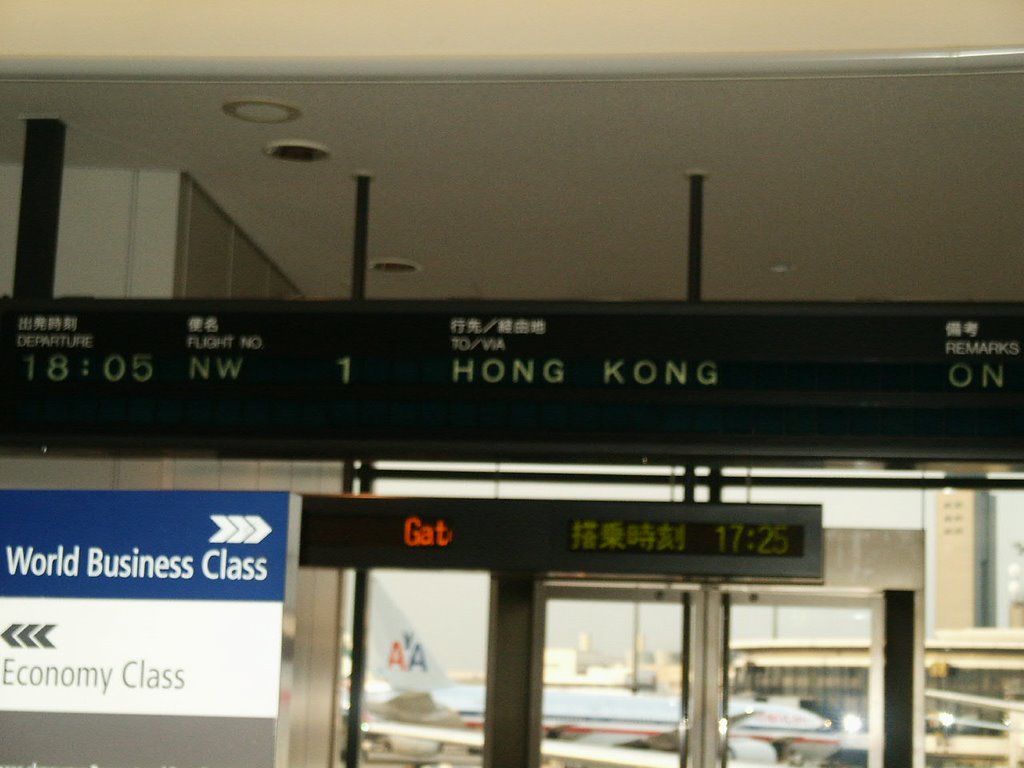
It was thirteen hours ahead in Hong Kong so I left Wednesday morning at 10:30 am and arrived Thursday night at 10:30 pm. But I actually spent around 24 hours of actual travel time including a four hour lay over in Tokyo.
The Salvation Army in Hong Kong has a beautiful hotel and command headquarters. I checked into the room and met my roomate Duncan Parker. Duncan is the Director for International Development for the United Kingdom. He greeted me by saying, "I hear I should call you J-Rock." I couldn't believe that my nickname had made it around the world:)

So as I lay in bed that night around midnight over there, 11 am back here in the states I felt excited about the days ahead and the place where the Lord had brought me.

Friday, March 31, 2006
In Hong Kong
Hi everyone
Just a quick note to let you know that I am in Hong Kong. I will be gone for another week still. Please keep me in your prayers as today we leave for mainland China.
Just a quick note to let you know that I am in Hong Kong. I will be gone for another week still. Please keep me in your prayers as today we leave for mainland China.
Wednesday, March 22, 2006
China - Touch Their Poverty!
I have been asked to be a part of a human trafficking assessment team to Mainland China. I will be going with a team of Salvation Army leaders to various project sites within poor communities in China which are at risk for human trafficking. My role on the team will be to see the situation through the eyes of a westerner and give my feedback as to how this problem may best be communicated to the west. My goal for the trip is to "touch their poverty." Or rather I want to be touched by their poverty! I want to feel the discomfort of their living to the point of it breaking my heart.
This is something that The Salvation Army has always been called to do. Last August I was able to read, "Good Morning China!" a book by Lt. Colonel Check-Hung Yee which tells the history of The Salvation Army in China. In an epilogue his daughter says, "As you step back in time and experience God’s transforming work in this generation of brave soldiers, may your heart also leap and be fanned to flame with the bond of love for China’'s 1.3 billion souls.’ As I read this book that is exactly what happened. I found myself with a burning desire to go to China and see the army at work there.
I plan on coming back to the states with a renewed vision and passion for God's calling on my life for the world. I will be leaving next Wednesday and coming back on April 8th. I would love to ask you all to support me and the team. Please pray for us even now as we prepare to go. On my return it is my plan to provide a report of the trip on this blog.
One friend wrote to say the Lord had layed the following verse on his heart regarding this trip:
'You will go out in joy and be led forth in peace; the mountains and hills will burst into song before you, and all the trees of the field will clap their hands. Instead of the thorn-bush will grow a pine tree, and instead of briers, the myrtle will grow. This will be for the Lord's renown, for an everlasting sign which will not be destroyed.'
Isaiah 55:12
I am raising support to cover the cost of this trip. If you feel that you would like to help support this trip financially or would just like more information please contact me at Jason_Pope@uss.salvationarmy.org.
PS. Below is a copy of some information on China's Trafficking problems.
People’s Republic of China
China is the world's fourth largest country, with a population exceeding one billion two hundred and ninety million (1,290,000,000) and average life expectancy of approximately seventy-two (72) years. Urban unemployment is estimated at ten percent (10%) and substantial unemployment and underemployment exists in rural areas. The poverty rate is ten percent (10%).6
Human trafficking is an acute problem in China ? a problem which has been and will continue to be exacerbated by the country’s one-child policy.7 The common cultural preference of families for boy children has led to a thriving practice of selective abortion of female babies. The result is serious gender disproportion which has left millions of men without potential spouses. To illustrate, approximately one hundred seventeen (117) boys were born for every one hundred (100) girls in 2000, compared with one hundred eight and one-half (108.5) in 1982. In the southern provinces of Hainan and Guangdong, the ratio was one hundred thirty to one hundred (130:100). A natural ratio would be one hundred four to one hundred seven, compared to one hundred (104 to 107:100).8 Thus, the effort to find wives had led to a flourishing traffic in women and girls, internally and from countries such as Burma, North Korea, Laos and Vietnam.9 Police are said to have freed forty-two thousand two hundred and fifteen (42,215) kidnapped women and children in the past two years.10
In March 2004, Li Weixiong, vice-chairman of a committee studying population issues told a government advisory body that a “dramatic rise” in levels of prostitution and the buying and selling of women was “by no means a sensational prediction.” He stated that if the situation continues, by 2020 there could be thirty (30) to forty (40) million men who would stay single all their lives.11 This will create an unprecedented and overwhelming demand for women. In addition to trafficking for commercial sexual exploitation and brides, there is also traffic of male babies for adoption.12
The U.S. Department of State’s 2004 Trafficking in Persons Report noted, “Chinese women are trafficked to Australia, Burma, Canada, Malaysia, Japan, Taiwan, the Philippines, Europe, and the United States” for purposes of prostitution.13 China is given a Tier 2 ranking in the report, indicating that its government does not comply with the minimum standards of the U.S. Trafficking Victims Protection Act of 2000 but that it is making significant efforts to come into compliance.14
Sunday, March 19, 2006
Military Metaphor or War
There is a conversation going on on Phil Laeger's blog which was continued from Larry's blog. Stephen makes a comment that The Salvation Army is engaged in a real war and not just using military metaphor.
I don't think it matters as much to me if we are in a real war or if we are using warfare metaphor to describe the life that we live as Christians. What matters to me is that we are called to share the gospel with millions of people who do not know Christ. By using military terminology we are hurting our opportunities to share the gospel with millions of people who have seen Christians over the centuries abuse power to try and spread the gospel through physical, military force rather than the force of love. Whether we are in a real battle or a metaphoric battle, we should drop describing our actions in battle terms because it is ineffective and hurtful to our purposes.
What do you think?
Monday, March 13, 2006
Flying Kites at Night
I was pretty blessed by One Time blind this past weekend. They were great on the stage and all but I was actually blessed by something different.
We were at youth councils on the beach in Jekyll Island Georgia. Saturday morning at 7:30 am there was a polar bear swim in the ocean. I am on the staff that put on the weekend but I was not interested in waking up that early or in going in the freezing cold water. Reluctantly I went down to the water, anyway. One Time Blind was a guest drama group that we had hired to come to the weekend. The two girls from the group got up and came out to the polar bear swim.
I was shocked to see them. They were an outside group and many times the outside groups only show up to the meetings which they are on the schedule. But here were these girls making me look silly for having wanted to stay in the hotel room.
Not only that but later that night they also came to the young adult pizza party and had what I considered to be some of the worst pizza I have ever tasted. One of their members couldn't even eat pizza and they had the option to go into town but they wanted to be with us.
Following the young adult party they wanted to go fly kites on the beach. Now mind you it was like 1:30 in the morning. But their merch table had glow sticks on it and they had decided that they wanted to see what would happen if they attach their glow sticks to the kites and fly them at night. As we walked down toward the beach we noticed that the wind wasn't really blowing.
The kites that we had were worth about a dollar and broke as we ran down the beach dragging them through the sand because there wasn't enough wind to get the kites in the air. Failure? Maybe not.
I was so thankful for the spontaneous, craziness of the moment. I was thankful to stand on the beach and look out over the wet sand to the place where the water had receded to as a result of low tide. I was thankful to see the sky stretch on for miles over the ocean.
I was thankful because somewhere along the way a small bit of the passion has slipped. It used to be that the kite flying would have been my idea and I would have went swimming just for fun. Life had lost a touch of luster. And the group reminded me to keep having fun.
Monday, March 06, 2006
This Much and No More!
Yesterday,I went to worship at the Lakewood Corps. Captain Marion Platt spoke on the passage of scripture from Acts 5 which outlines the story about Ananias and Saphira. They had sold a piece of their property, gave some of the money to the church and then told everyone that they gave all of the money to the church. They wanted the credit without the sacrifice. Better yet, they wanted to take from community without giving to community. Its a shady way of doing business. They thought they could get ahead by taking more out than they put in.
Continuing on from my last post, Did he or didn't he? The rich young ruler wanted to be a part of the community. He had given the preliminary elements but he had held back from the community that which he was most uniquely endowed to contribute. God blesses all those who earnestly believe in Him. But some are blessed monetarily, some through wisdom, some through relationships, some through gifts of healing and the list goes on. But the strongest gifts that we are given are also the ones that are most difficult to give back to God's kingdom.
If we want to be a part of God's kingdom then we must give what is our best. As one of my friends has put so elegantly:
Thank you for showing me the emptiness of all I held onto, I surrender it all, I surrender my everything for you. P. Laeger (AKA P Diddy)
So in the case of the widow who took her last penny and dropped it in the offering plate, Abraham who raised the knife in the air over his son, or Keith Green who said he wouldn't play music any more until God blessed him or the rich young ruler who walked away sad...we all have an opportunity to give that "Best" thing which God has given us back to Him.
And He is able to make the camel walk right through the eye of the needle.
Tuesday, February 28, 2006
Did He or Didn't He?
Today some friends and I were discussing the parable of the rich young ruler. You know, its the one where Jesus says to the rich young ruler, "Don't steal" "Don't lie" ect. and you will find the kingdom of God.
The rich young ruler replies that he has already done all that. Then Jesus says, "Well then sell all of your posessions and give them to the poor." At this point, in my understanding the rich young ruler went away sad because in my understanding it was the one thing that he couldn't give.
But in all three versions of the story all it says is that the rich young ruler went away sad. Now somebody may comment that the Greek says this or that...I don't know...
But I realized, thanks to my friend Bernie, that maybe, just maybe the rich young ruler did give away all his possessions. Perhaps this is more a commentary on the sacrifice it takes to follow Jesus and the emotions of sadness that we may sometimes have to feel when we are holy and set apart for him.
And of course I don't think that sadness lasts always. I don't think that the rich young ruler remained sad (if he did give away all his things). I think that eventually he became a content middle aged pauper or something...full of joy, living in the kingdom.
Kind of gets me thinking about living in the kingdom myself.
Sunday, February 26, 2006
God is so good
This spoke to me tonight...
God Is So Good
--------------------------------------------------------------------------------
1. God is so good, God is so good,
God is so good, God's so good to me.
2. God cares for me, God cares for me,
God cares for me, God's so good to me.
3. God loves me so, God loves me so,
God loves me so, God's so good to me.
4. God is so good, God is so good,
God is so good, God's so good to me.
Thursday, February 23, 2006
Making it my home
Home is where we feel comfortable or as the overused phrase goes, "where the heart is."
My wife and I recently moved into a new house (may 2005). Following the examples of some courageous salvationist, Major John and Marty Needham, Captains Geoff and Sandra Ryan, Captains Stephen Court and Danielle Strickland we were inspired to move into the heart of the city.
Frankly, I was scared to death. My perception of the inner city was that it was hostile to people like me. People like me? What do I mean? Middle class, white, suburban, best schools all my life, low crime...ect. I thought my mere presence in this area would provoke violence against me and my family.
Things were quiet for the summer and I started to feel a little comfortable there. I thought, "It may just not be that bad." Then in August, a new neighbor moved into our block. It was obvious by the foot traffick and gun shots that came with the new neighbor that this was a bad element in the neighborhood. It took three months but the police eventually caught on and the Highly trained drug task force officers arrested my new neighbor. We had a visitor in the middle of the night the night of the arrests that blocked my car in and came knocking on my back door.
I had taken a self defense class once and the instructor had told us that nothing good ever comes from behind. The guy was arrested on my property when he didn't have a good reason for being there.
All of my past fears kicked back up again. For two weeks we stayed out of the house. I read on Carole's web site that when she went to Eastern Europe she started praying, "Lord, Make this my home."
That thought has stayed with me. I began praying that prayer. I had been living in a house but I wanted it to be my home.
The other day my next door neighbor, a recent transfer from New Orleans came over and asked for prayer because her husband, an alchoholic had disappeared two days before with her truck. We prayed with her and a couple of days later he showed back up. She has taken him to the hospital for help (again). Then the next night my neighbor across the street, a single mom with five children who works outside the city, had her car repossessed at 4 am. She came and asked for a ride to the grocery store the next day. My dad was over and we were happy to take her.
And over the course of time I have begun to have a different perspective about the place where I sleep at night. I may not be an outsider. I am just one of them. My home is in a dangerous place. But it isn't just my house that is there. It is my heart and my neighbors. And I am thankful for the models of courage that have led me here.
Monday, February 20, 2006
February
Found this on the web somewhere:
Whatever storms we have weathered,
whatever difficulties we have endured these
past few weeks,
We are at least grateful now for a noticeable
lengthening of days:
For more abundant sunlight glancing off icicles,
resplendent upon snowy fields.
We have reached a turning point in winter, and
though remote, Spring seems possible now.
Nevertheless, February spreads out before us,
a short but often frigid month – winter’s
doldrums, we would say.
Holiday gaiety is already half-forgotten; daf-
fodils, those harbingers of Spring, still are
deeply dormant.
And what consolations has February to offer?
What does it promise besides four weeks of
cold, Lenten discipline and lessons in self-
denial?
It is, thank heaven, a month restricted in most
years to twenty-eight days. Who would
wish it more?
And yet, this can be a precious time; an oppor-
tunity for making and renewing connections,
for forging bonds of community.
A dearth of distractions is the hidden blessing
of February:
No World Series, Kris Kringle or Cows on the
Concourse.
It is free of graduations; weddings and vaca-
tions are also few.
What good, then, is February?
Of all the months of the year, it is the one
during which we can be most present for
one another –
At home, in the workplace and in our spiritual
community. If this unpraised and underap-
preciated month is in may ways a test of
our endurance, may it also be a test of our
affections.
And may we remember that when we hold
onto each other and skate through it
together,
February can be warm, and it can be quite
lovely. (MAS, 2002)
Friday, February 17, 2006
Republic of Georgia
I have been to the Republic of Georgia on three different mission trips. Whenever I tell people this they generally look at me with a blank stare as if to say, "you live in Georgia." Then I go on to explain to them that it is a country in the former soviet union.
The first trip that I took to Georgia was in 1995. It was just a couple of years after the soviet union fell so the air of democracy was still fresh at the time. We spent ten weeks there running camps for refugee children, doing open airs, preaching in church, teaching in Sunday School and visiting corps members homes. It was the most intensive soldier training I have ever seen. It changed my heart and life. From that point on I knew that I wanted to be involved with life changing ministry.
The Second trip that I took to Georgia was in 1999. My fried Curtis was working there at the time as the Divisional Youth Officer. A group of friends and I had put together a band to play some songs at our youth councils here in Georgia, USA. I started to think about the kids in Georgia. Our youth councils could drop thousands of dollars on a weekend event. Our brass bands take trips each year which cost thousands of dollars. Why could we not spend some money to send this band over to georgia so their kids could enjoy what our kids take for granted? Well, I put together a proposal, and I began to realize how political things can get in a headquarters city. But I knew that this would be a good thing so I stuck with it. And God opened the doors and the trip happened.
We spent a month there ministering through our music but also through relationships. I saw my friends find they same love for Georgia that I had. I saw kids ministered to through out music. I saw a vision accomplished.
My third trip I went back to Georgia by myself upon the request of Gia and Eka Salarishvilli. They were corps officers of the Rustavi corps and they wanted me to come up with ideas for them in their teen ministry. What I saw on this trip broke my heart. Water was only on from 6am-8am each day. The School systems were inefficient and corrupt. Unemployment rates were extremely high. Hopelessness was prevalent.
On this trip I met three boys who were around 12, had never been to school, begged for money all day and then used the money to buy bags of glue to sniff. They were filthy dirty. As a shower every day american, it was difficult for me to love them. But I heard God saying, "Touch their poverty!" It was his voice that broke my heart. I reached out and have never been the same since.
Short term mission trips can change people's lives. They can add a depth of perspective and character not achievable in the states. I have heard some say why do we spend so much time sending our youth off on these "adventures?" It is because "God loves the world so much that He sent His only son that whosoever (this means the dirty street kids on drugs who don't have an ounce of hope to hang their hat on are as eligible as the businessman down the street) will may be saved."
Subscribe to:
Posts (Atom)